Blog
Glass Bottle Manufacturing Methods for Bulk Wine Packaging
A Technical Overview for Wineries and Beverage Brands
For wineries and beverage producers sourcing glass bottles in bulk, manufacturing consistency is a critical performance factor. Beyond aesthetics, the glass bottle forming method determines dimensional accuracy, closure compatibility, pressure resistance, and long-term storage reliability.
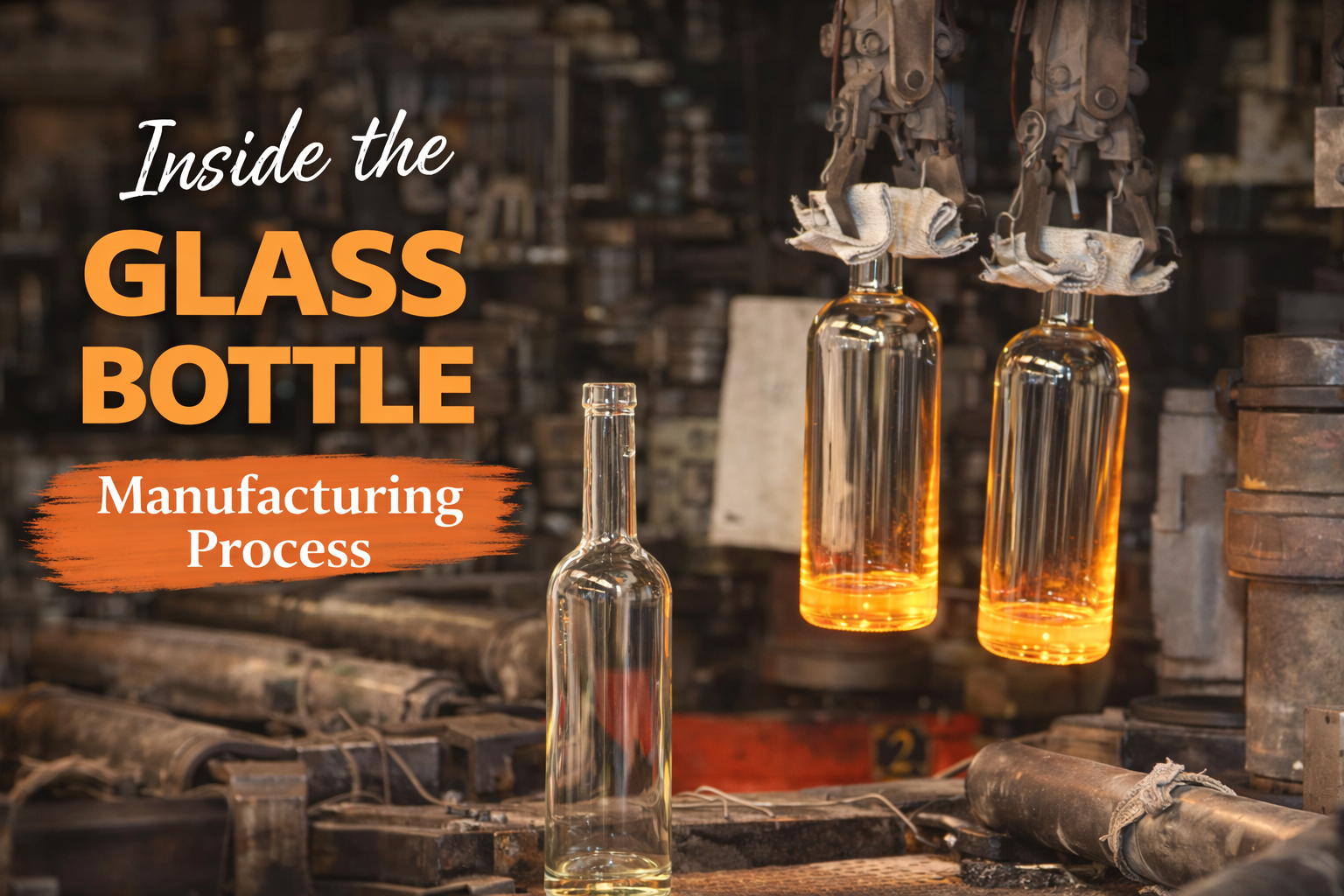
As a certified glass bottle manufacturer supplying large-volume winery and spirits brands, we operate fully automated forming lines designed for high-precision, repeatable wine bottle production. This guide explains modern glass bottle manufacturing methods, highlights the best processes for wine bottles, and outlines how advanced process control ensures stable quality at scale.
Why Glass Bottle Manufacturing Methods Matter in Bulk Orders
In industrial bottling environments, small dimensional variations can lead to:
-
Filling line disruptions
-
Closure sealing failures
-
Uneven internal pressure distribution
-
Increased transport breakage
For this reason, wineries increasingly evaluate suppliers based on forming technology and production stability, not just price or design.
The Evolution of Wine Bottle Manufacturing
From Handcrafted Glass to Industrial Standardization
Historically, glass bottles were hand-blown and shaped manually. While suitable for artisanal applications, handcrafted bottles lacked consistency and could not support modern high-speed bottling operations.
With the expansion of global wine markets, manufacturers transitioned to mechanized and fully automated glass forming systems, enabling mass production of standardized containers.
Fully Automated Glass Bottle Production: The Modern Industry Standard
Today’s wine bottle manufacturing relies on advanced IS forming machines integrating:
-
Precision multi-cavity molds
-
Controlled compressed-air forming
-
Computerized temperature management
-
Continuous annealing tunnels
These systems support hundreds of thousands of bottles per day while maintaining tight dimensional tolerances across extended production runs.
For wineries requiring bulk glass bottle supply, automated forming technology is essential.
Primary Glass Bottle Forming Methods for Wine Bottles
Most wine bottles are produced using one of two core container-forming methods:
Blow–Blow Forming
Used for standard wine bottles such as 750 ml and 375 ml narrow-neck formats.
This method delivers uniform wall thickness, accurate neck finishes, and reliable pressure resistance, making it ideal for high-volume production.
Press–Blow Forming
Applied to thick-bottom bottles, large-format bottles, and premium spirits packaging.
A metal plunger pre-shapes molten glass, enabling precise base thickness control, improved weight balance, and enhanced structural stability.
Blow–Blow vs Press–Blow: Selecting the Right Method
| Requirement | Recommended Process |
|---|---|
| Standard wine bottles | Blow–Blow |
| Thick-bottom bottles | Press–Blow |
| Premium / heavy designs | Press–Blow |
| High-speed bulk production | Blow–Blow |
| Custom large formats | Press–Blow |
Selecting the right forming method ensures optimal performance, cost efficiency, and production stability.
Why Other Glass Forming Techniques Are Not Suitable for Wine Bottles
Alternative glass forming methods—such as float glass, drawing, or casting—are designed for flat or tubular products and cannot produce hollow containers with precise neck finishes or controlled internal volume.
Wine bottle manufacturing requires dedicated container-forming technology to meet packaging and filling-line requirements.
Quality Assurance in Bulk Glass Bottle Manufacturing
Reliable bulk supply depends on strict process control and inspection systems:
-
Automated temperature regulation to stabilize glass viscosity
-
High-precision molds dedicated to each bottle design
-
Inline visual inspection for defects such as cracks, bubbles, or dimensional irregularities
-
Controlled annealing to reduce internal stress and improve impact resistance
All production complies with SGS, LFGB, and international food-contact safety standards, ensuring safe and reliable wine packaging.
Choosing a Glass Bottle Supplier for U.S. and European Wineries
When selecting a bulk wine bottle manufacturer, wineries should evaluate:
-
Automated forming capacity
-
Production scale and delivery reliability
-
Consistency across large production runs
-
Compliance with food-contact and packaging regulations
-
Customization capability for branded bottle designs
A supplier with advanced forming technology ensures stable supply, consistent quality, and long-term cost efficiency.
Work With a Reliable Bulk Glass Bottle Manufacturer
If you are seeking a trusted glass bottle supplier for bulk wine packaging, we offer advanced forming technology, scalable production capacity, and customized bottle solutions.
Contact us today to request samples, discuss bottle specifications, and evaluate the best manufacturing method for your wine brand.